In the last post, a tap travelled from a coffee shop to a bank and back in two seconds (usually, in 2 seconds, but can go beyond that – and this overall acceptable response time varies by countries/regions). Several parties handled it on the way, and the same few names keep coming up. This post pins down what each one does, because most questions later in this series start with the same one: whose job is this?
At the two ends are the cardholder, who pays, and the merchant, who gets paid.
Behind the cardholder is the issuer, the bank or institution that issued the card and holds the account behind it. The issuer decides whether each payment is approved, and it carries the risk if the cardholder doesn’t pay or the transaction turns out to be fraud.
Behind the merchant is the acquirer, the institution that serves the merchant. It receives the merchant’s transactions, sends them into the card network, and pays the merchant.
Between the two sits the network, Visa for example. It connects issuers and acquirers, so a merchant doesn’t need a separate agreement with every bank. It sets the rules, routes the messages, and works out who owes whom when it comes to settlement.
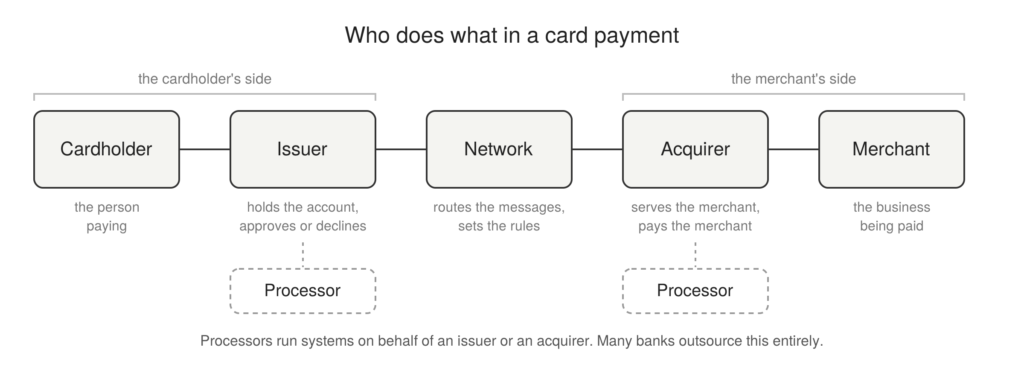
One more name appears constantly: the processor. A processor is a technology provider that does work on behalf of an issuer or an acquirer, such as running the authorization system, keeping card records and producing the files. Many banks outsource this entirely, so the system that answers a message may not belong to the bank whose name is on the card.
Newer card programs add two more roles. A program manager is a company, often a fintech, that builds a card product on top of someone else’s licence. The BIN sponsor is the licensed issuer that makes this possible by lending its bank identification number and its network membership (but not force you to use their systems). I’ll come back to both. In the issuing side, you can see players that offer you all in one pack – they are the BIN sponsor, they have their platforms with issuing processing capabilities. So, you do not need to assemble the pieces together.
The model bends in places. One company can be both issuer and acquirer. Some markets route local debit through a domestic scheme instead of a global network. But the roles still hold: someone issues, someone acquires, and something connects them.
When a payment goes wrong, the most useful first question is which role owns the problem. A decline usually starts with the issuer. A merchant who hasn’t been paid is usually an acquirer question. A message that never arrives often points to a processor or the network.
Leave a Reply