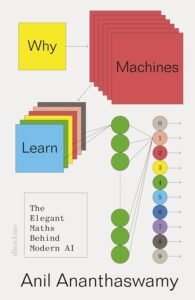
Why Machines Learn rewards slow reading. It is structured less like a linear argument and more like a guided walk through the intellectual terrain that made modern machine learning possible. Each major section takes a foundational idea—learning rules, error correction, representation, probability—and places it within a longer scientific lineage, showing how today’s algorithms are not sudden miracles but accumulated responses to old problems.
Early in the book, Ananthaswamy grounds the idea of learning in biology and evolution. Before a single artificial neuron appears, the reader is reminded that learning long predates computers. Natural selection itself is framed as a learning process: variation generates hypotheses, the environment supplies feedback, and survival acts as an error signal. This framing quietly prepares the reader for everything that follows. When machine learning algorithms later appear, they feel less like clever hacks and more like engineered echoes of processes that have been unfolding for millions of years. This evolutionary perspective distinguishes the book from more engineering-first accounts such as Machine Learning: A Probabilistic Perspective, which begin inside the mathematics rather than outside it.
When the book turns to artificial neural networks, it does so with unusual care. The discussion of perceptrons and early neural models is not nostalgic; it is diagnostic. Ananthaswamy explains why early enthusiasm collapsed—most famously with the limitations highlighted by Minsky and Papert—and why those limitations were not incidental but structural. Single-layer networks could not represent certain classes of problems, no matter how much data they were given. This historical failure sets the stage for one of the book’s most important technical ideas: multilayer networks and the problem of credit assignment.
The chapter dealing with backpropagation is one of the clearest non-technical explanations available to general readers. Rather than presenting backprop as a magical trick, Ananthaswamy frames it as a solution to a specific question: how does a system with many internal components decide which parts are responsible for an error? The idea of propagating error signals backward through a network is explained as a bookkeeping method, not an act of intelligence. Each layer adjusts itself slightly, guided by gradients that indicate how sensitive the final outcome is to its parameters. What makes this explanation effective is its insistence on modesty. Backpropagation is powerful not because it “understands” anything, but because it is brutally efficient at minimizing mistakes under well-defined constraints.
This treatment stands in contrast to more triumphalist narratives found in books like Deep Learning, where backpropagation is presented primarily as a workhorse technique. Ananthaswamy instead emphasizes its conceptual fragility. It depends on differentiability, stable gradients, and carefully tuned architectures. Remove these conditions, and the learning process quickly becomes unstable or meaningless. This emphasis on fragility becomes a recurring theme.
When convolutional neural networks enter the story, the book again resists hype. CNNs are introduced not as vision engines but as architectural constraints inspired by biological vision systems. Weight sharing, local receptive fields, and hierarchical feature extraction are explained as efficiency measures rather than cognitive breakthroughs. The reader is shown how convolution exploits spatial structure, drastically reducing the number of parameters a system must learn. This makes CNNs practical, not intelligent. The book carefully notes that these networks do not “see” objects in any human sense; they detect statistical regularities in pixel arrangements that correlate with labels supplied by humans.
This chapter is particularly effective in demystifying why deep learning succeeded when it did. The convergence of architectural ideas, massive labeled datasets, and cheap computation is presented as historical contingency rather than inevitability. In this respect, the book aligns with the sober tone of Prediction Machines, which treats AI advances as economic shifts driven by falling costs, rather than as steps toward artificial minds.
Probability and uncertainty form another major pillar of the book. Ananthaswamy devotes significant attention to probabilistic thinking, emphasizing that much of machine learning is about managing uncertainty rather than uncovering truth. Bayesian inference is discussed not as a niche statistical technique but as a philosophical stance: beliefs should be updated in light of evidence. The book shows how probabilistic models provide a language for reasoning under incomplete information, whether in spam filtering, speech recognition, or scientific discovery.
What is notable here is how the author connects probability to learning itself. Learning is framed as belief revision, and data as experience. This allows probabilistic models and neural networks to be discussed within a shared conceptual space, even when their mathematical tools differ. Readers familiar with Pattern Recognition and Machine Learning will recognize many of these ideas, but Ananthaswamy’s contribution lies in showing how they address the same underlying problem: how systems adapt in a world they cannot fully observe.
The later chapters of the book widen the lens again, returning to neuroscience and cognitive science. The relationship between artificial networks and biological brains is treated with caution. Similarities are acknowledged, but so are deep differences. Brains learn with far less data, operate under severe energy constraints, and are embedded in bodies with goals and histories. Machine learning systems, by contrast, are narrow specialists trained in artificial environments. This comparison serves as a corrective to claims that deep learning is on a direct path toward human-level intelligence.
Throughout the book, there is a consistent resistance to anthropomorphic language. Terms like “understanding,” “reasoning,” and “thinking” are handled carefully, often with quotation marks or explicit caveats. This restraint gives the book a credibility sometimes lacking in popular AI writing. It places Why Machines Learn closer to reflective works like The Embodied Mind than to speculative futures literature.
What ultimately ties these chapters together is a quiet philosophical claim: learning is not a single thing. It is a family of processes shaped by constraints, objectives, and environments. Machine learning works astonishingly well in domains where these elements can be tightly controlled. It struggles elsewhere. The book never says this outright as a thesis, but it emerges naturally from the accumulation of examples.
As a result, Why Machines Learn does not leave the reader with a sense of awe so much as clarity. It explains why certain techniques work, why others failed, and why progress in this field has been uneven and surprising. It neither dismisses machine learning as mere statistics nor elevates it to synthetic intelligence. Instead, it situates it where it belongs: as one of the most successful—and limited—tools humans have devised for extracting structure from data.
For readers willing to engage patiently with its arguments, the book offers something increasingly rare in discussions of AI: understanding without exaggeration. It does not ask the reader to fear machines, nor to worship them. It asks, more simply, that we pay attention to how learning actually happens, and why it takes the forms it does.
Leave a Reply